
Understanding Load Paths in Multi-Storey Buildings
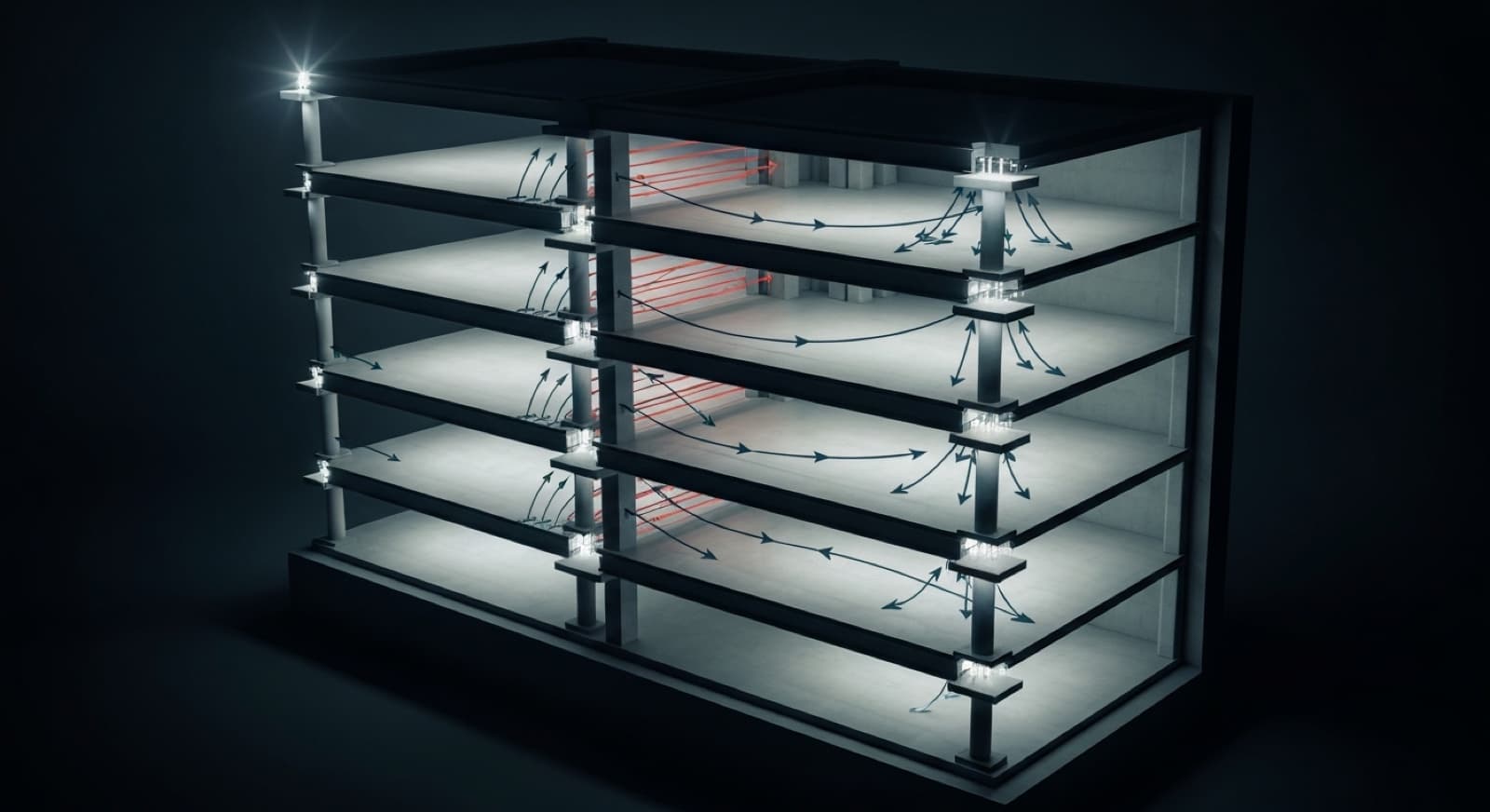
From Roof to Ground
Load path is one of the most fundamental concepts in structural engineering, and it's one of the first things I explain to every graduate engineer who joins ACSES.
The principle is simple: every load applied to a building - gravity, wind, earthquake - must have a continuous, uninterrupted path through the structure to the foundations, and from the foundations into the ground.
How Gravity Loads Travel
Imagine rain falling on the roof of a 10-storey building. That rain adds weight to the roof slab. The roof slab transfers that weight (along with its own self-weight) to the beams supporting it. The beams transfer the load to columns. The columns transfer the load down through every floor to the foundations. The foundations spread the load into the ground.
At every level, the loads accumulate. The ground floor column is carrying the weight from all ten floors above. The foundation beneath that column is carrying the column load plus its own weight. It's a cascading system.
When Load Paths Go Wrong
- Removed walls. I've lost count of the number of times I've been called to assess a building where someone has removed a wall that was carrying load. The wall above is now spanning across an opening it was never designed to span. Cracks appear, deflections increase, and in extreme cases, collapse can occur.
- Misaligned columns. When columns on upper floors don't align with columns on lower floors, the loads need to be transferred horizontally through transfer beams or slabs. These transfer elements carry enormous forces and must be specifically designed for the purpose.
- Interrupted bracing. For lateral loads (wind and earthquake), bracing systems need to be continuous from roof to foundation. A bracing bay that stops at Level 5 doesn't help the building resist wind at Level 10.
Why This Matters for Developers
If you're planning a development with different uses on different floors - say commercial at ground level with residential above - the column grid will almost certainly change between uses. This creates transfer conditions that require careful engineering.
The cost and complexity of transfer structures is directly related to how far the loads need to be transferred horizontally. A 2-metre offset is manageable. A 6-metre offset requires a substantial transfer beam or slab. The earlier we're involved in the architectural planning process, the more efficiently we can resolve these transfers.
The Practical Lesson
Whether you're a builder, developer, or homeowner, the load path principle has practical implications:
- Never remove a wall without engineering advice
- Understand that structural changes on one level affect everything above and below
- Column and wall positions are not arbitrary - they follow a structural logic
- Transfer structures are expensive - minimise them through early coordination with your engineer
Every structure is a system. Every element is connected to every other element through load paths. Understanding this principle is the foundation - literally - of sound engineering practice.
George Khalil, Principal Engineer

Related Articles

Tell us about your project.
We will respond with a clear understanding of how we can assist.
Partner With Us