
Stormwater For Sites That Fall Away From The Street
When a site falls away from the street, the first answer is a drainage easement through the downstream property to a public drain, because it lets the water run by gravity. Pumps, charged lines and absorption systems only come into it when an easement cannot be obtained, and councils want to see that one was genuinely sought first.
Sending the water onto the neighbour's land without an approved path is not an option. It is the kind of problem that ends up in court.
Why gravity comes first
A gravity pipe has no moving parts and needs no power. It keeps working in a blackout in the middle of a storm, which is exactly when a pump is most likely to fail.
That is why council stormwater policies rank the options the way they do. Gravity to the street comes first, gravity through an easement comes second, and everything else is a fallback that has to be justified.
An easement through the downstream lot
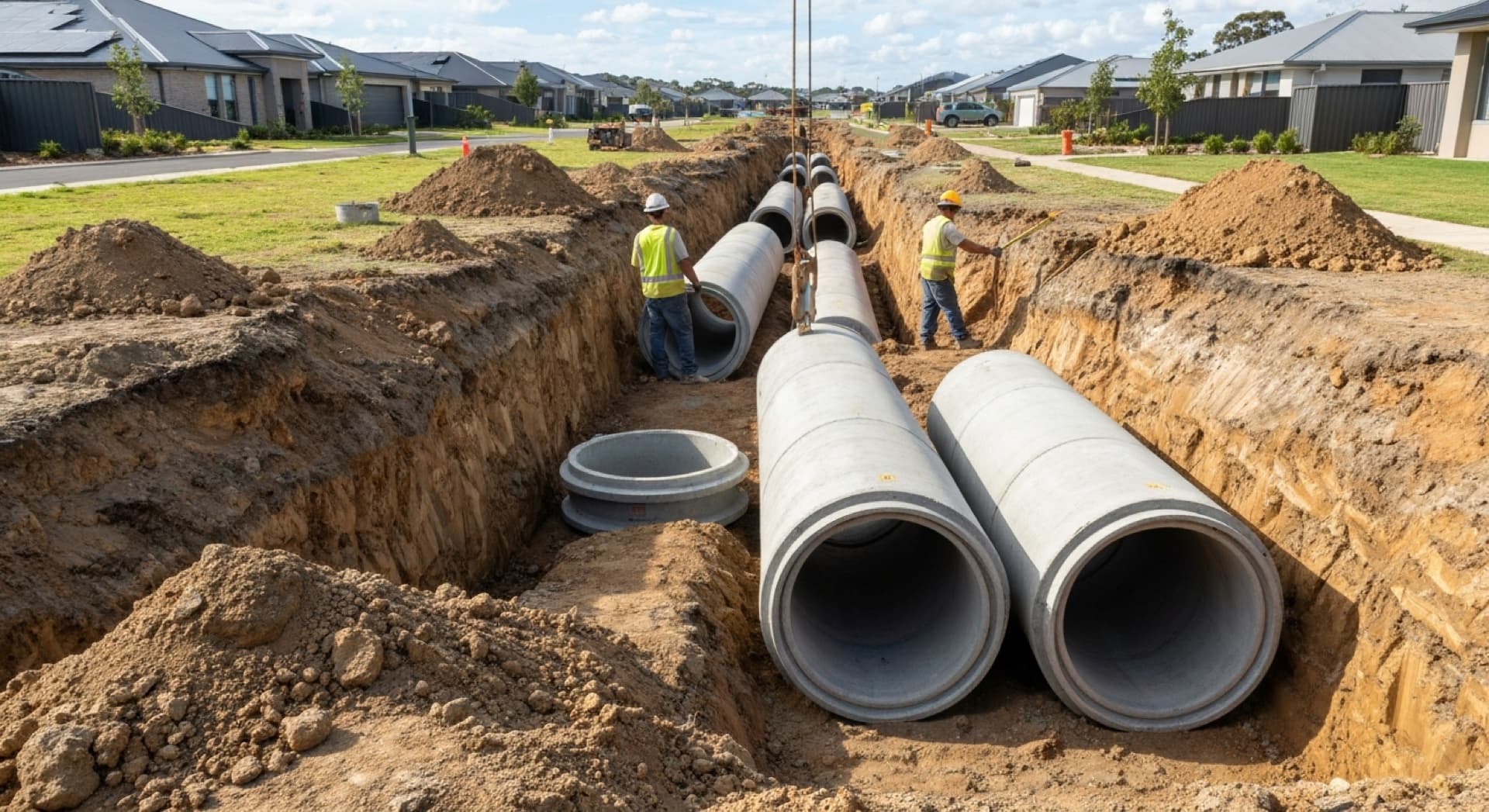
An easement gives the site a legal right to run a pipe through the neighbouring property, usually along a boundary, to a council pit or drainage line.
It starts with a conversation. The downstream owner is approached, a route is agreed, and the owner is paid for the easement and for the work on their land. The easement is then registered on the title so it binds future owners too. We design the pipe size, the route and the pits, and the neighbour's land is restored once the pipe is in.
When a neighbour says no
Under section 88K of the Conveyancing Act 1919, a court can impose an easement where it is reasonably necessary for the development of the land.
The applicant has to show that reasonable attempts were made to get the easement by agreement, and the owner of the land it crosses is compensated. It is slower and more expensive than an agreement, but it exists, and councils will often want to know it has been considered before they look at a pump.
Councils commonly ask for written evidence of the attempts, such as the letters sent and the replies received, before they will assess an alternative.
When an easement is not possible
A charged system. Roof water is collected in sealed pipes and pushed up to the street by the height of water standing in the downpipes. It only works for roof water in a fully sealed system, the pipes hold water between storms and collect silt, and councils treat them cautiously, often limiting them to roof water.
A pump-out system. Councils accept pumping for areas that have no other path, such as a basement ramp, with two pumps, an alarm and storage for when a pump fails. The design is covered in [basement stormwater pump-out systems](/blog/basement-stormwater-pump-out-systems).
Absorption. Soaking water into the ground only suits free-draining sand. On Sydney clay it fills up and stays full, and on a slope it puts water exactly where it does harm, as discussed in [steep sites and landslip risk land in Sydney](/blog/steep-and-landslip-risk-sites-sydney).
Site levels
Before reaching for any of those, the site levels are worth a hard look.
Raising the ground floor slightly, collecting the roof at the street side, and shaping paved areas so they fall to the front can send most of the site's water to the street by gravity. What is left at the rear is then a small area, not the whole site. The same levels drive the driveway, so they are worked out together, as covered in [driveway grades and basement ramps](/blog/driveway-grades-and-basement-ramps).
Overland flow
Pipes are designed for a set storm. A bigger one overflows and runs across the surface, and on a site that falls to the rear, that overflow heads for the back boundary.
The design keeps a clear overland flow path, with floor levels set above it and nothing built across it. The wider principles are in [stormwater management for urban developments](/blog/stormwater-management-urban-developments).
How we approach it
We survey the site and look for the downstream drainage before the architectural levels are fixed, because the answer to this question can move a ground floor. Where an easement is needed, we prepare the drawings the neighbour and the council both need to see, and we raise any fallback with the council early, not at the end.
Water always finds the low corner. The design decides whether it arrives there in a pipe or through the neighbour's back fence.
ACSES provides civil engineering, including stormwater and drainage design, across Sydney. Talk to us about a project.
Building Relationships Beyond Structures

Related Articles
Tell us about your project.
We will respond with a clear understanding of how we can assist.
Partner With Us