
Foundation Design - Raft vs Piled vs Strip Footings Explained
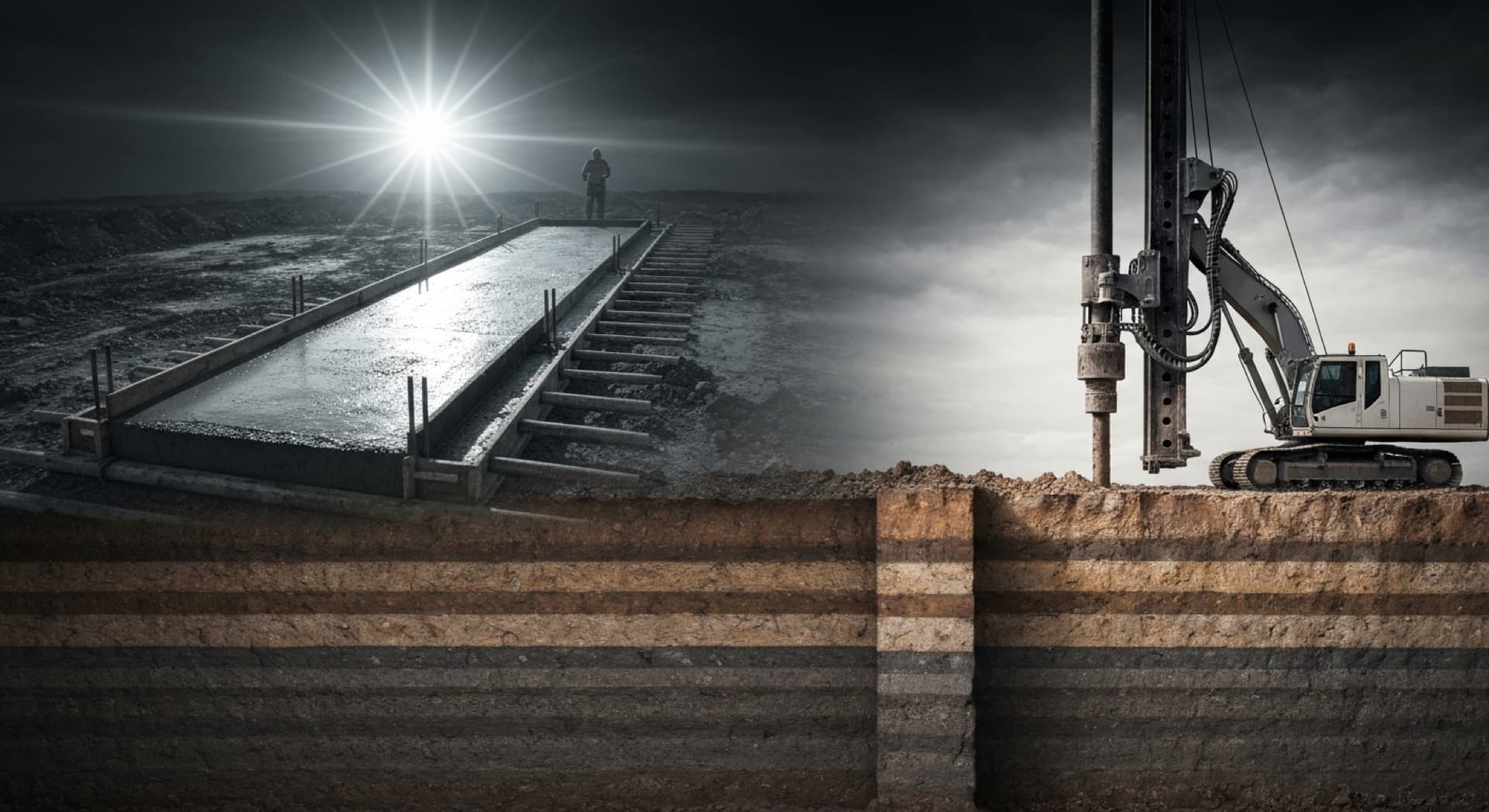
Getting the Foundation Right
Foundations are the least glamorous part of any building, but they're arguably the most important. Get the foundation wrong and everything above it is compromised. Get it right and you've set the project up for success.
Strip Footings
What they are: Continuous concrete footings that run beneath load-bearing walls. The simplest and most economical foundation type.
When we use them: Low-rise construction on good ground. Residential houses, duplexes, and small commercial buildings where loads are moderate and ground conditions are favourable.
Advantages: Low cost, simple to construct, minimal excavation required.
Limitations: Not suitable for heavy loads, poor ground, or sites with variable bearing capacity.
Raft Foundations
What they are: A continuous concrete slab that covers the entire building footprint, distributing all building loads across the full ground contact area.
When we use them: When the ground bearing capacity is low relative to the building loads, or when differential settlement needs to be controlled. Common for multi-storey residential buildings on variable ground.
Advantages: Spreads load over large area, reduces differential settlement, provides a basement floor slab, can accommodate moderate variations in ground conditions.
Limitations: Uses more concrete than strip footings, requires careful design for bending and shear, can be expensive for large footprints with low loads.
Piled Foundations
What they are: Deep foundation elements that transfer building loads through weak surface soils to stronger material at depth - either competent rock or dense bearing strata.
When we use them: Heavy structures, poor surface conditions, or when the competent bearing stratum is too deep for shallow foundations.
Types commonly used in Sydney:
- Bored piles - Drilled into the ground using a rotary auger. Can be socketed into rock for high capacity. Diameters from 450mm to 1800mm or more.
- Continuous Flight Auger (CFA) piles - Installed using a hollow-stemmed auger. Concrete is pumped through the stem as the auger is withdrawn. Fast and economical for moderate loads.
- Screw piles - Helical plates on a steel shaft, screwed into the ground. Quick to install, good for light to moderate loads.
How We Decide
The foundation selection process at ACSES Engineers follows a clear logic:
- Review the geotechnical report - What's in the ground? What bearing capacity is available at what depth?
- Calculate the loads - What forces does the building impose on the ground?
- Assess settlement - Will the ground deform acceptably under the applied loads?
- Consider constructability - Can the selected foundation be installed efficiently with available equipment?
- Compare costs - What's the most economical solution that satisfies all technical requirements?
The reality is, foundation design is as much about geotechnical understanding as it is about structural analysis. The best foundation is the one that's matched to the actual ground conditions on your specific site.
George Khalil, Principal Engineer

Related Articles

Tell us about your project.
We will respond with a clear understanding of how we can assist.
Partner With Us