
Trade Waste Compliance for Commercial Sydney Projects
Trade Waste Compliance for Commercial Sydney Projects
Any commercial project that discharges anything other than domestic effluent into Sydney Water's sewer needs trade waste approval. The list of triggers is long: restaurants, cafes, bakeries, mechanical workshops, commercial laundries, healthcare facilities, dental practices, photographic processors, food manufacturers, distilleries, cooling towers, and many more.
If your project hosts any of these uses, you need trade waste approval BEFORE the certificate of occupation. Skip it and the certificate is held back. We've seen developers lose handover by weeks over trade waste oversights.
What Sydney Water Requires
Trade waste is regulated by Sydney Water under the Sydney Water Act and the Environmental Planning and Assessment Act. The approval framework distinguishes between three categories:
- Standard agreement — covers low-risk trade waste like food premises with grease arresters
- Non-standard agreement — for higher-risk discharges requiring custom pre-treatment (commercial laundries, mechanical workshops)
- Industrial agreement — for major industrial discharges (chemical, food manufacturing, hospitals)
Most commercial developments fall into the standard or non-standard category. Each requires:
- Identification of the discharge type and characteristics
- Pre-treatment design (grease arrester, oil/water separator, neutralisation tank, etc.)
- Plumbing design ensuring trade waste streams discharge to the trade waste outlet, not domestic sewer
- Maintenance and disposal arrangements
- Sampling and monitoring obligations as conditions of approval
The Engineering Pieces
Trade waste compliance requires the right pre-treatment for the discharge type:
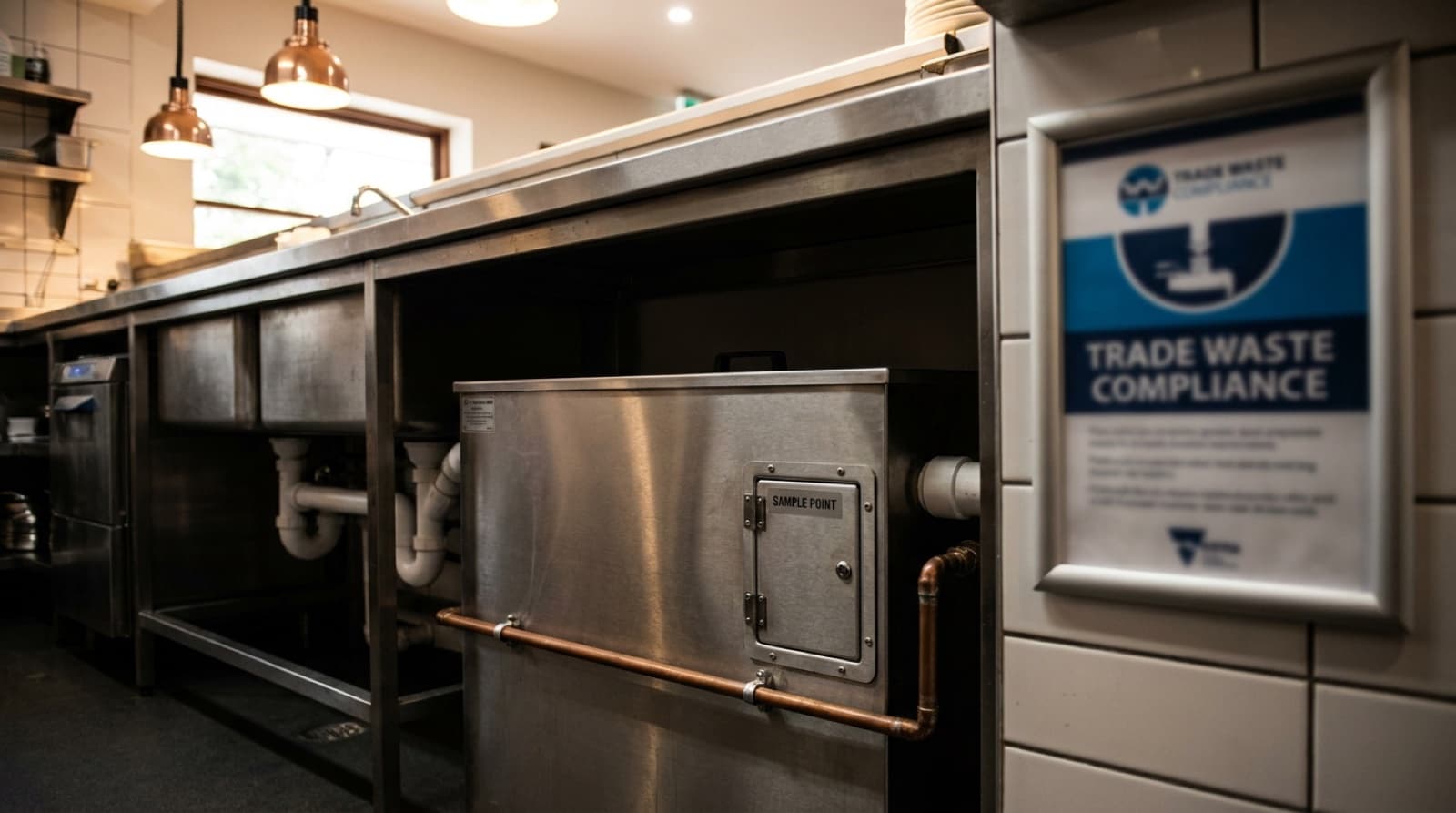
Grease arresters for any food premises. Sized based on fixtures connected (typically 1000-3000L for a typical restaurant). Must be accessible for pump-out by a licensed contractor.
Oil and water separators for any vehicle workshop, cooling tower, or fuel-handling facility. Often coupled with a sample point for ongoing testing.
Neutralisation tanks for any process discharging high-pH or low-pH effluent. Sized based on flow and pH variation.
Sampling chambers at the trade waste outlet for any non-standard or industrial agreement. Sydney Water's testing access point.
Backflow prevention between trade waste streams and any potable, recycled water, or fire system supplies.
What Goes Wrong
The most common failure modes we see:
Underestimating the trade waste boundary. Many developers think trade waste applies only to obvious uses (food, mechanical). It applies broadly. We've seen photographic studios, dental surgeries, even commercial fitness centres trigger trade waste requirements.
Insufficient pre-treatment. A grease arrester sized for a small cafe undersized for the actual fitout. Trade waste approval becomes conditional on system upgrade — usually after the cafe fitout is committed.
Inadequate access for maintenance. Pre-treatment systems need regular pump-out. If access is constrained (e.g. inside a basement carpark with no truck access), the asset becomes effectively unmaintainable. Sydney Water rejects that arrangement.
Late engagement. Trade waste applications often arrive late in the certificate cycle. Standard agreements process in weeks; non-standard in months. Late submission delays handover.
The ACSES Pattern
We engage with trade waste from concept stage where commercial uses are anticipated. Our typical pattern:
- Identify all anticipated uses and confirm trade waste triggers
- Design pre-treatment with adequate capacity and maintenance access
- Plumb the development with trade waste segregation built in (not bolted on)
- Prepare the trade waste application early, in parallel with the building application
- Coordinate site testing and Sydney Water sign-off as part of handover
For mixed-use developments where the commercial fitouts haven't been determined at construction stage, we design the base building to accommodate likely uses — sized risers, dedicated trade waste lines, capped connections — so individual fitouts can be approved without re-engineering.
The Bottom Line
Trade waste compliance is not optional and is rarely fast. Done properly from concept it adds modest engineering effort. Done as an afterthought it can stall handover and trigger expensive rework. We design it in, not on.

Related Articles
Tell us about your project.
We will respond with a clear understanding of how we can assist.
Partner With Us