
Recycled Water Integration in Sydney's New Developments
Recycled Water Integration in Sydney's New Developments
Recycled water is reclaimed wastewater treated to a quality suitable for non-potable uses — toilet flushing, irrigation, washdown. In Sydney's planned communities (Rouse Hill, Pitt Town, Oran Park, North-West Growth Area), it's a standard part of the servicing offer. In existing suburbs, it's increasingly available and increasingly required.
Why It Matters for Engineers
Three drivers push recycled water into Sydney developments.
The first is Sydney Water's own infrastructure planning. By offsetting potable demand with recycled supply, Sydney Water defers expensive headworks upgrades. Where recycled mains are available, connection is encouraged or, increasingly, required.
The second is BASIX. NSW's Building Sustainability Index awards points for recycled water connection. For larger projects, BASIX targets are difficult to meet without recycled water, solar, or rainwater integration.
The third is operating cost. Recycled water typically prices below potable. Over a development's life, the savings on irrigation and toilet flushing can be substantial.
What Connects to What
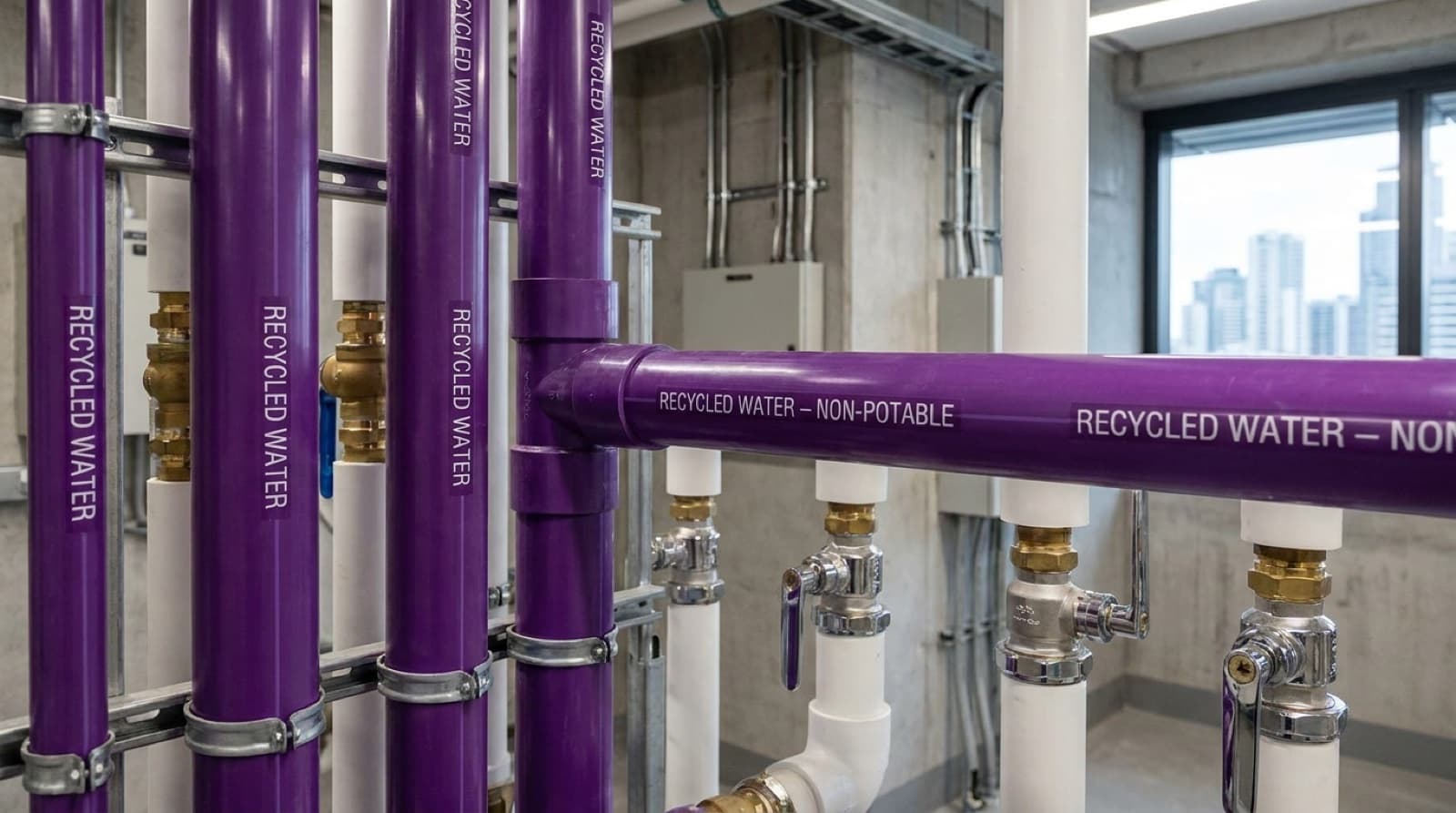
Sydney Water's recycled water network is fully separated from the potable system. Recycled water is delivered through its own purple-pipe main, with its own meter, and into building plumbing that's plumbed entirely separately.
The fixtures that legally accept recycled water in NSW residential and commercial buildings:
- Toilet cisterns (single and multi-flush)
- Outdoor irrigation taps and systems
- Washing machine cold supply (residential, with caveats)
- Outdoor washdown taps
- Cooling tower makeup and certain industrial process water
What recycled water does NOT supply: any potable use. No drinking, no kitchen, no bathing, no laundry hot water connection.
Plumbing Engineering Requirements
The plumbing design has strict separation requirements to prevent any potable contamination:
- Purple pipe (PVC-U, marked "Recycled Water — Not for Drinking") for all recycled supply
- Air gaps or backflow prevention at every connection point to potable
- Cross-connection control testing at handover
- Mandatory dual-mark on all recycled fixtures
- Plumber's certification of separation
Sydney Water Approval Pathway
For sites in recycled-water-served areas, the connection pathway parallels the potable pathway:
- Confirmation of recycled water availability at the connection point
- Recycled water demand assessment (often factored into Section 73 documentation)
- Internal plumbing design with full separation evidence
- Cross-connection testing and certification before handover
For sites NOT currently served, you cannot retrofit a connection without a network extension — and recycled water network extensions are not generally available on demand. The engineering question becomes: is the BASIX or sustainability target achievable through alternative pathways (rainwater, increased efficiency)?
What We See in Practice
The successful recycled-water-integrated developments we've worked on share three characteristics.
Early commitment. The decision to integrate recycled water at concept stage, not as a retrofit. The plumbing risers, fixtures, and meter locations are designed in from the start.
Separated documentation. Two separate plumbing layouts — potable and recycled — are produced as a deliverable. Mixing them on one drawing creates installation errors and certification failures.
Coordinated approval. The Section 73 application includes recycled water in addition to potable. Treating it as a separate process triggers double the review cycles.
The Sustainability Win
For developers targeting Green Star, BASIX, or specific ESG metrics, recycled water is one of the highest-impact integrations available. It directly reduces potable demand by ~30-40% in residential applications, and contributes meaningfully to project-level water efficiency claims.
ACSES delivers integrated civil and plumbing engineering for recycled water across Sydney's served areas. We design the system, document the approval, and certify the cross-connection separation that gets the project handed over without rework.

Related Articles



Tell us about your project.
We will respond with a clear understanding of how we can assist.
Partner With Us