
Pressure Sewer Systems vs. Gravity Sewer for Sydney Developments
Pressure Sewer Systems vs. Gravity Sewer for Sydney Developments
Most Sydney developments connect to gravity sewer because most sites fall the right way. When they don't — and increasingly in challenging geometries — pressure sewer is the engineering answer.
How Each System Works
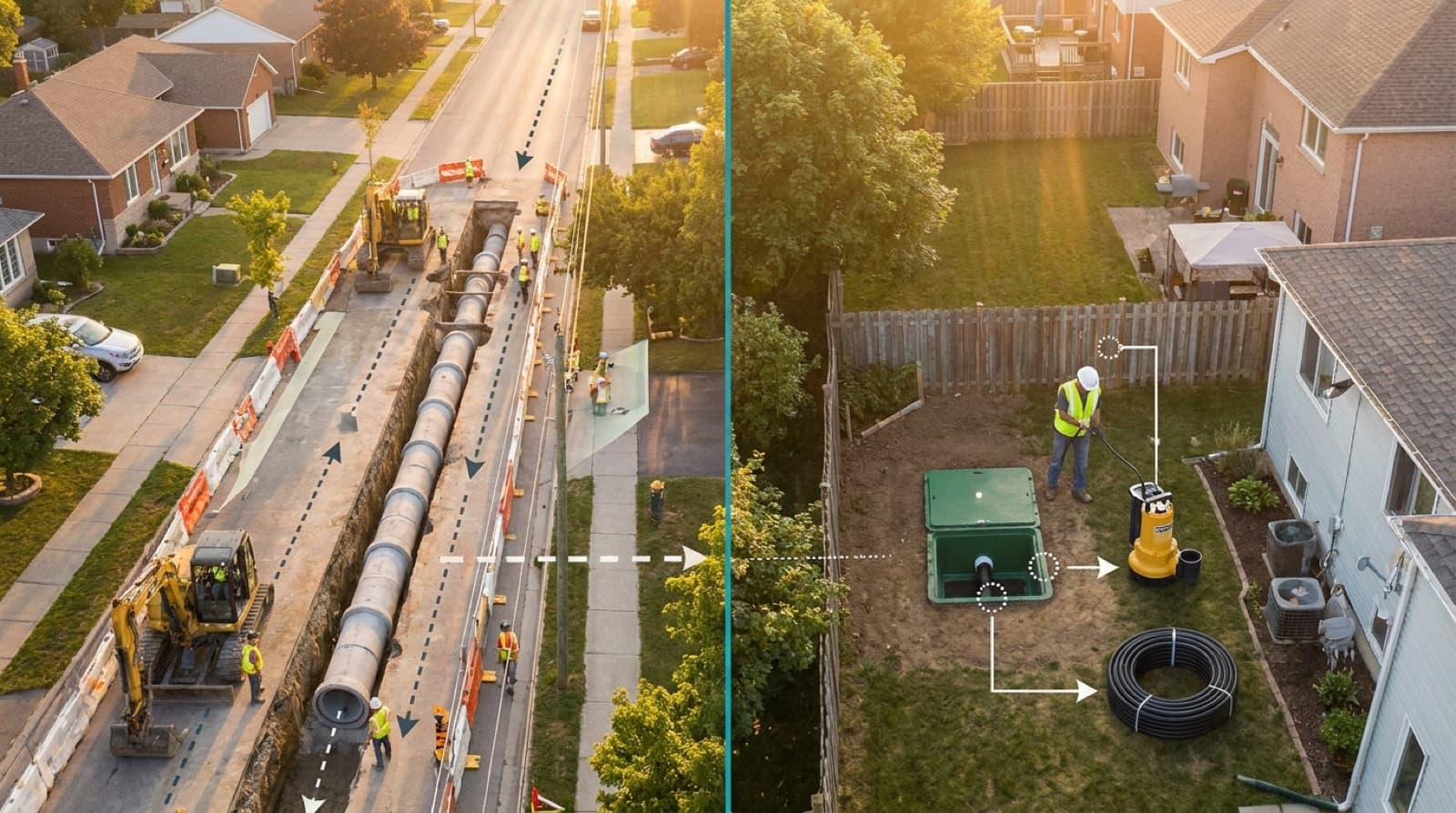
Gravity sewer is what most engineers default to. Sewage flows from fixtures to the street main under gravity, helped by pipe gradient (typically 1:60 minimum to 1:80 for larger pipes). It needs continuous fall from highest fixture to point of connection. No moving parts, no power, low ongoing cost.
Pressure sewer uses a pump unit at the property boundary or within the building to push sewage uphill, around obstacles, or over long horizontal distances. The collection pump unit (typically a grinder pump) sits in a small chamber. It pumps a slurry through small-diameter pressure mains.
When Gravity Doesn't Work
Pressure sewer is the right answer when one of three conditions applies:
- Site falls the wrong way — fixtures at higher elevation than the connection point in the street. Common on sloping back blocks, basement levels below natural ground, or sites where the sewer is uphill.
- Long horizontal runs without fall — large sites where the connection point is far from the building and the natural fall is insufficient.
- Easements or obstacles in the gravity path — a pre-existing structure, watercourse, or Sydney Water easement that prevents a clean gravity alignment.
Trying to force gravity in any of these scenarios creates expensive solutions: pump-out wells, deep-dig connections, alignment around obstacles. Pressure sewer often delivers the same outcome for less cost.
Sydney Water Approval Pathway
Sydney Water has a published pressure sewer technical specification. Approved unit types and approved configurations are the easy path. Custom configurations require specific approval.
The approval typically includes:
- Pump unit specification (E/One or equivalent)
- Pressure main sizing and material (typically PE100, with specific pressure rating)
- Surge analysis for longer runs or multiple connection points
- Air valve placement and venting strategy
- Pump unit redundancy (typically dual-pump for shared systems)
- Power supply backup (for critical sites)
Cost Comparison — Real Numbers
A typical detached house gravity connection in suburban Sydney costs $4-8K depending on distance and depth. A pressure sewer connection runs $12-18K including the pump unit, chamber, alarm, and pressure main. Operating cost adds approximately $50-100/year for power.
For a sloping site where gravity would require a deep cut — say, a 4m+ trench, possibly through rock — gravity can easily exceed $25K. Pressure sewer wins on cost.
For multi-unit developments, the comparison is more nuanced. Shared pressure sewer systems require more engineering (surge, capacity sharing, alarm) but eliminate the need for individual gravity connections, which simplifies the basement/site geometry significantly.
Where Pressure Sewer Goes Wrong
The two failure modes we see are misuse and undersizing. Misuse: pressure sewer was installed because gravity was "too hard," when a properly engineered gravity solution would have worked at lower lifecycle cost. Undersizing: insufficient pump capacity for peak loads, or insufficient pressure main diameter for total dynamic head.
A proper engineering analysis at concept stage avoids both. ACSES civil engineering routinely specifies the right system based on first-principles flow and head calculations, not defaults.
The Decision Framework
Choose gravity when: site falls toward the connection point, the natural drop is sufficient (~1% minimum), and the alignment is unobstructed.
Choose pressure when: any one of the three conditions above applies and a gravity solution would require deep excavation, complex routing, or compromised yield.
We design both. The decision is made by the project, not by the default.

Related Articles
Tell us about your project.
We will respond with a clear understanding of how we can assist.
Partner With Us